

When Everything Becomes Background Noise
On sound and the spaces that capture our attention to listen.

ESSAY // AA-SA-001
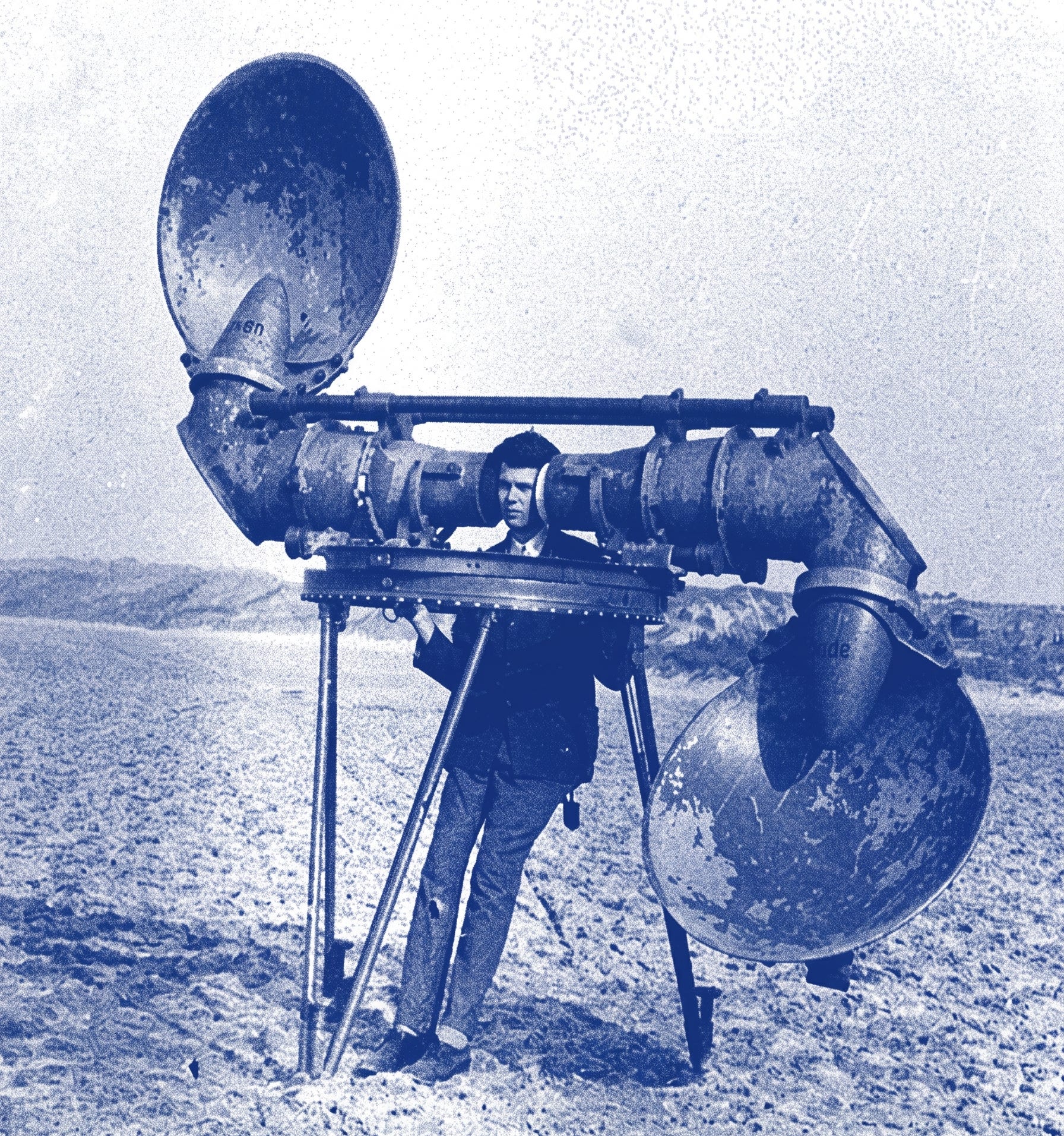
Circa 1928: Tests with a half-Goerz listening device.
The modern world isn’t just getting louder; it’s getting faster and that speed is exhausting. We live in a strange paradox: we have access to every sound ever recorded, yet we’re losing the ability to truly listen.
We’re submerged in a daily tide of alerts, messages and digital static. We play music while we work, answer messages while we walk and let conversations drift into the background while our screens flash. We have adapted to a pace that we struggle to keep up with and in doing so, we’ve learned to put on headphones, not just to listen to the world, but to protect ourselves from it.
We are surrounded by sound, yet increasingly detached from the act of listening.
The early desire to focus and amplify listening produced machines like this: giant ears for pulling signal from noise. Later, the same acoustic logic would turn around and become the language of horn loudspeakers.
When we talk about “background noise” we usually mean the physical stuff; the hum of traffic, the buzz of construction, the roar of a crowded restaurant. And while those things wear us down, they’re only the surface layer.
The constant sound is the informational noise. It’s the endless feed, the incoming notification, the algorithmic suggestion, the half-read article. It’s the image we consume before we understand it and the song we skip before it’s even had the chance to unfold. It’s not just a sound; it’s an atmosphere of constant interruption.
The real question isn’t whether the world has become too loud. It’s whether we’ve learned to treat everything, every piece of music, every conversation, every moment as if it were background noise.
To live in a city today is to become a professional filter. We ignore the traffic, the voices and the clutter just to make it from A to B. But a habit built for survival eventually leaks into how we live our lives. We start filtering the experience itself.
The habits of the screen migrate into our bodies. We move through music, rooms and conversations with the same reflex we use online: scan, judge, skip, continue. Instead of letting something exist on its own terms, we ask immediately: Is this worth my time? Does this give me what I want?
This matters because listening is how we stay in relationship with the world. Anthropologist Steven Feld calls this acoustemology: sound as a way of knowing. Feld writes that “sound is a fully capacious way of knowing.” Listening, in this sense, is not simply the reception of vibration. It is how a body locates itself inside a place, a culture and a field of memory. Listening isn’t passive; it’s one of the most active things we can do.
Think about music. Some music announces itself immediately. Other music builds on the space between notes. It asks for duration, for air, for patience. A bass note isn’t just a frequency; it’s a physical event. A room tone isn’t decoration; it’s the atmosphere that lets the recording breathe. Silence between sounds isn’t empty; it’s where the tension gathers.
This is why certain records feel hollow when treated as background. They weren’t made to decorate an activity; they were the activity.
An album is a sequence, an argument, a passage. The beginning prepares your body. The middle changes the room. The ending returns us differently than when we arrived. When we skip tracks too quickly, we don’t just miss the songs, we miss the sonic architecture between them. The sound reaches the ear, but it never reaches the listener.
We have a harder time focusing because we are constantly reacting to the world instead of engaging with it. But within that friction, there is an opportunity to reclaim the conditions for belonging.
Sound has a unique power here: it gathers attention without demanding that it be captured visually. It moves through the body before it becomes language. A room changes when the right sound enters it. A person changes when they allow themselves to listen.
During the early Acoustic Architecture listening sessions, this became immediately clear. When people were invited to slow down, their relationship to the music changed. They accepted the sequence. They trusted the arc. They allowed one piece of music to lead into another. Sounds, instruments, lyrics and music began to synchronize, harmony was formed.
That is the distinction. Listening is not just receiving sound; it is the decision to be present.
To listen deeply is to suspend the impulse to judge, to optimize, to compare, or to move on. It asks the self to become quiet enough for something else to appear.
The same is true of the room itself. Acoustician Dr. Stefan Weinzierl, professor at TU Berlin, observes that rooms are not perceived directly, but through their effect on the sound source, the signal and the listener. The room is never just a container. It decides what arrives intact, what is blurred, what is masked and what the body can remain with. This is why the design of listening rooms matter. Not as a luxury object or a monument to equipment, but as a device for slowing down perception. It removes the usual excuses. There is no screen to refresh, no spectacle to chase, no algorithm deciding what comes next. The room asks the listener to stay.
High-end listening culture becomes relevant again when it not only focuses on fidelity, but grows into more emotional conditions. What feeling should the room give to the listener? What allows a listener to become receptive?
These are human questions. If we cannot listen, we cannot reflect. If we cannot reflect, we cannot understand ourselves or world around us.
Creativity needs this space. It needs impressions that don’t yet have a use. It needs encounters that aren’t immediately productive. It needs the mind to wander without being redirected.
A sound becomes a feeling. A feeling becomes a memory. A memory becomes part of how we understand ourselves.
When everything becomes background noise, the task isn’t to escape the world. It’s to create moments where something can return to the foreground.
Acoustic Architecture begins there.
The first architecture was sound.
Sound only becomes architecture when attention gives it weight.
Steven Feld, “Steven Feld on his book, Acoustemology,” CaMP Anthropology, February 3, 2025. https://campanthropology.org/2025/02/03/steven-feld-on-his-book-acoustemology/
Dr. Stefan Weinzierl, Steffen Lepa, and Martin Thiering, “The Language of Rooms: From Perception to Cognition to Aesthetic Judgment,” TU Berlin DepositOnce. https://depositonce.tu-berlin.de/items/09404de1-a320-41f6-bd57-967055157f73