


ESSAY// AA_SA_002
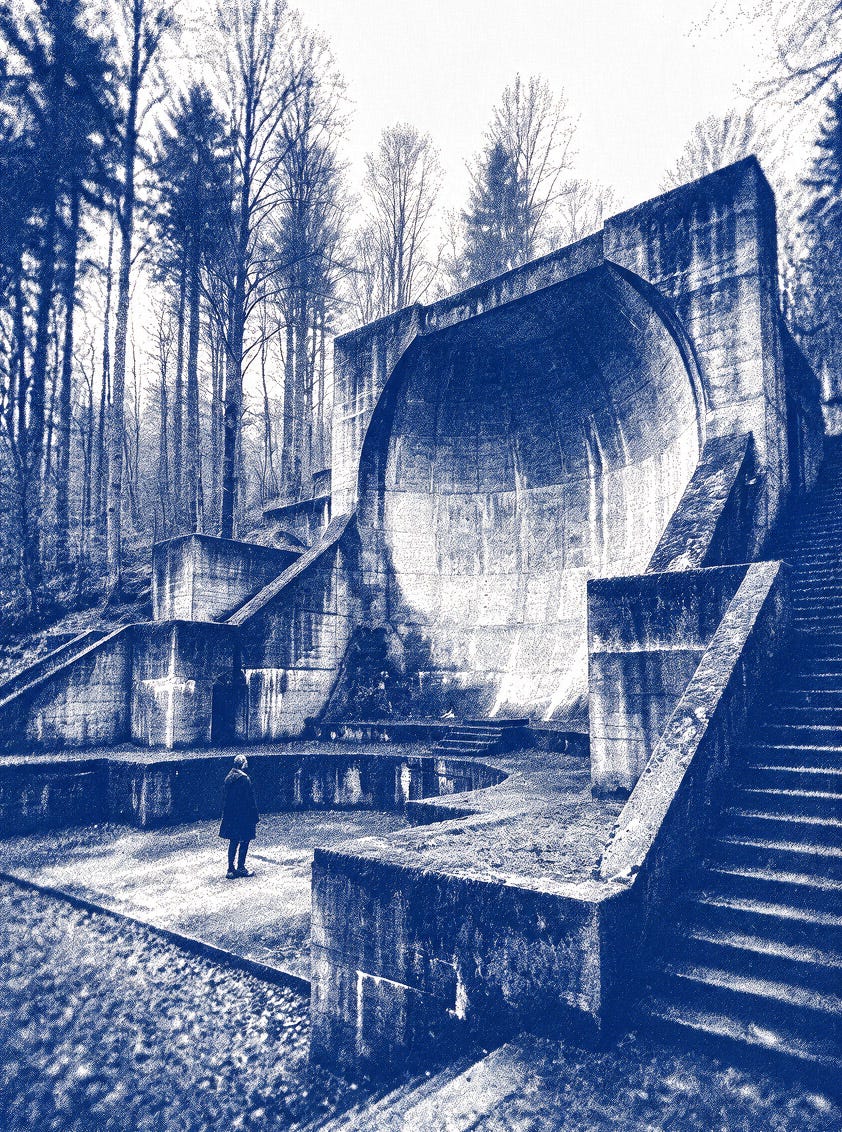
There’s a stretch of the Tiergarten where I like to lie down in the grass with my eyes closed, present until the chorus of sound disappears and its nuances gradually emerge into the foreground. The leaves move in bursts, fast and uneven, then suddenly still. Beneath the rustling is the tranquil calm of the canal, barely changing, but equally important. The distant chatter of people chimes in just long enough to catch a few words, carrying the rest of the phrase away with them, never fully knowing what was said. This acute awareness doesn’t come from listening harder. Almost the opposite, in fact. It happens once I stop trying.
I’ve done some version of this most of my life, finding a patch of grass or warm sand, closing my eyes and hearing the sound signature of a city. A park in Berlin doesn’t sound like one in Los Angeles, and a city by the ocean has something running underneath it that an inland city never will. Children playing, footsteps, wind moving through trees, a bird somewhere above you, traffic a few streets away. I have this strange idea that you could blindfold someone, drop them into three places they knew well and, if they listened for a few minutes, they could probably tell you where they were. Most of us probably could. We just never get asked to.
Somewhere alongside all of this, we became extraordinarily good at seeing. I wrote in my notebook that we had entered an “age of seeing,” which sounds much more dramatic now than it did when I wrote it, but I still think there is something there. Over roughly the last century we developed an incredible visual vocabulary. Cinema gave us worlds to enter. Photography allowed moments to be stopped and replayed. Television brought moving images into the home. Digital cameras made producing images almost free, and the smartphone eventually put a camera, an editing studio and a distribution network into everyone’s pocket. Then we built platforms where billions of people could show each other what they were looking at.
I don’t mean that as an argument against any of it. I love technology, and I’m probably more interested than most people in what happens when a new technology changes the way we experience something. The interesting part is that these technologies didn’t just give us more pictures. They trained us. We became incredibly sophisticated at processing visual information, presenting ourselves visually, judging objects visually and communicating through images. We can read a landscape almost instantly. A color can change our emotional response to an object before we have even consciously decided what we think about it. A tiny logo can tell us which tribe somebody belongs to. We built a very advanced sensory culture around looking.
At the same time, the day fills up before it starts. There are calendar invites to check, DMs to answer, a delivery that is two stops away, emails, another notification, some small thing you were supposed to remember yesterday. Work turns into lunch and lunch turns back into work, then maybe dinner, maybe the gym, and suddenly the day is gone. Whatever little pieces remain in between are easily absorbed by an app. Five minutes of scrolling here, eight minutes there. It doesn’t feel like we gave up very much because none of those pieces of time were very big to begin with. But add them together and something has happened. We’ve divided much of our free attention into micro-tasks.
The idea of lying in the grass for an hour and listening to trees doesn’t necessarily get rejected. It just never comes up.
And yet sound never left us. Music moved from vinyl to cassette to CD to files to streaming and somehow ended up available almost everywhere, all the time. Cities didn’t become quieter. The wind kept moving through trees whether anyone was listening to it or not. Voices, traffic, birds, machines, rooms, footsteps, all of it stayed right where it was. Maybe these sounds seemed to disappear because we simply became too preoccupied to notice them. So that’s the part I keep turning over: if sound never went anywhere, why does it suddenly feel new?
Because lately I keep noticing listening showing up in places where it used to sit somewhere in the background. Listening bars are putting the sound system at the front of the photograph instead of hiding it behind the cocktails. Artists and institutions are treating sound as something that can organize an experience rather than simply accompany one. Architects are thinking more seriously about what a room does to our ears. High-fidelity culture, sound art, meditation, music, architecture and design are coming strangely close to one another. I don’t think they all got together and decided this. That would be much too convenient. They just seem to be arriving at some of the same questions from different directions.
Audeum in Seoul is probably the most extreme example I’ve encountered. It is a museum devoted to audio, built around an extraordinary collection and an obsession with sound. The building contains remarkable historical equipment, including enormous Western Electric theater systems. But the more I looked into Audeum, what interested me was that someone had built an entire building around the conditions required to listen to sound. The architecture itself is treated as part of the instrument. Materials, acoustics, light and movement through the building all prepare you for what happens when you finally sit down.¹
That changes the question. Instead of asking whether a hundred-year-old horn is somehow “better” than a modern loudspeaker, which can turn into the usual audiophile argument in about thirty seconds, I’m more interested in what the object asks you to do. You choose something to hear. There is equipment that has to be operated. There is a particular place to sit. The room has a character. You stay. The ritual surrounding the sound starts affecting your attention before the music even begins. Maybe what is being preserved at Audeum isn’t only the machinery. Maybe it is a particular way of giving yourself over to listening.
Strangely, I think I experienced another version of this through an app.
At the end of 2020, deep into Covid, I signed up for Clubhouse. It was actually the first social media platform I had ever seriously used, although in a slightly ridiculous twist I had to create an account on another unnamed social platform just to get myself onto it. Clubhouse was almost entirely audio. You entered rooms and listened to people talk. If somebody let you onto the stage, you could speak. Visually there wasn’t much there beyond a tiny circular profile picture, sometimes a photograph, sometimes a cartoon, sometimes something that told you almost nothing about the person at all. So low on the visual, high on the audible.
I started spending time in art and technology rooms and became strangely drawn into them. People came back to hear the same voices day after day. Some rooms would slowly transform into something closer to support groups. People cried. Strangers became remarkably open with each other. Obviously Covid had a huge amount to do with this. We were months into isolation and people were starving for human connection. I don’t want to rewrite that period into an experiment proving that audio is somehow more authentic than images. But it made me stop and think. Why did people seem willing to expose so much of themselves there? Was it just the circumstances, or did removing most of the visual information also change something about the conditions of the conversation?
Maybe it was both. We usually read people through an incredible amount of visual information, and we also use that information to manage how we are read. A face, clothes, a room behind someone, the camera angle, all the tiny decisions involved in being seen. Clubhouse removed most of that. You were left with timing, silence, tone, hesitation, laughter, breathing, the sound of someone searching for a word. Nobody stopped performing entirely, of course. But the performance had fewer materials to work with. I remember thinking that the absence of an image somehow shortened the distance between people. I’m still not sure exactly why. What I do know is that, at a moment when physical gathering had become almost impossible, people gathered around voices.
That starts to make listening seem less like a category of media and more like a condition. A room full of Western Electric horns and an audio-only social app have almost nothing in common as objects, yet both alter what is available for attention. One does it through architecture, equipment and ritual. The other did it almost accidentally by taking something away. In each case the interesting thing happens somewhere between the sound, the environment and the listener.
And maybe this is why I keep coming back to the very primitive image of people around a fire. Sound doing the gathering. Drums, voices, bodies arranged around a shared center. I’m not suggesting that a listening bar in Berlin is secretly an ancient tribal ceremony. Although, after midnight, some of them are probably not that far off. What interests me is the basic structure of the thing: people arranging themselves around sound and agreeing, for some amount of time, to pay attention together. We keep inventing increasingly sophisticated machinery and architecture to create a condition that is, in another sense, extremely old.
Pauline Oliveros understood something important about this long before I started trying to put words around it. Her practice of Deep Listening made a distinction between hearing, which is happening constantly and listening as something we can actively cultivate. The practice expanded outward from music into awareness of the acoustic environment, the body, imagination, other people and the spaces surrounding them. Listening became a way of paying attention more completely. Oliveros described it as going beneath the surface of what is heard while expanding toward the whole field of sound.²
I keep finding myself adjacent to that idea from a designer’s direction. Deep Listening asks what can happen when we expand awareness through listening. The question that gradually became Acoustic Architecture for me is slightly different: what happens if we intentionally design the conditions around that attention? What does the room do before a note is played? What do the objects tell you? What does the light do to your willingness to stay? What happens when the chairs are too far apart, or too close? What do the materials, the equipment and the proportions of the space communicate before anyone has explained what the experience is supposed to be?
This is where sound starts becoming material in a much broader sense. A loudspeaker matters, but so does the wall behind it. A record matters, but so does the act of choosing it. The distance between two people can change how they listen together. The light can make a room feel temporary or ceremonial. Even what happens before the music starts matters. Someone arriving, taking off a jacket, pouring a drink, settling into a chair. Then the record finishes and nobody immediately puts on another one. That silence afterwards can sometimes be part of the experience too.
I originally thought Acoustic Architecture would be mostly about sound. The more I work on it, the less sure I am. Maybe sound should not be overemphasized. Sound simply happens to be one of the most effective materials we have for creating the conditions in which perception can shift. It can open the door, but the experience happens through the room, the object, memory, attention and the other people who happen to be there with you. In that sense sound is almost an assistant. An unusually powerful one, but still part of a much larger composition.
Brandon LaBelle writes, “To listen is to extend the boundaries of the familiar, the recognized, and the known.”³ I keep returning to it because it describes something I recognize without turning listening into a mystical activity. Listening can change the edge of what we notice. Once that edge moves, even slightly, the familiar world can come back looking different.
Which brings me back to the Tiergarten. The trees were always making that sound. The canal was always moving underneath them. People were always walking past, leaving half their conversations behind. Nothing had been waiting for me to discover it. I had simply stayed still long enough for the sounds to separate and once they did, the place I already knew became unfamiliar again for a few minutes.
Perhaps this is why the most meaningful listening experiences stay with us long after the sound has faded—not because they changed what we heard, but because they changed how we returned to the world.
Notes
Audeum Audio Museum, Seoul. Architectural project description, 2024. [Kengo Kuma & Associates]
Pauline Oliveros, “What Is Deep Listening?” Center for Deep Listening, Rensselaer Polytechnic Institute. The text draws from Oliveros’s writing on Deep Listening and Quantum Listening: From Practice to Theory (To Practice Practice).
Brandon LaBelle, ed., The Listening Biennial Reader, Vol. 1: Waves of Listening. Errant Bodies Press, Berlin, 2023.